Cost & planning7 min read
How Much Does It Cost to Drill a Well in Central Texas?
Per-foot rates, what's actually included, and the four things that move the number more than anything else.
Cody Sterling
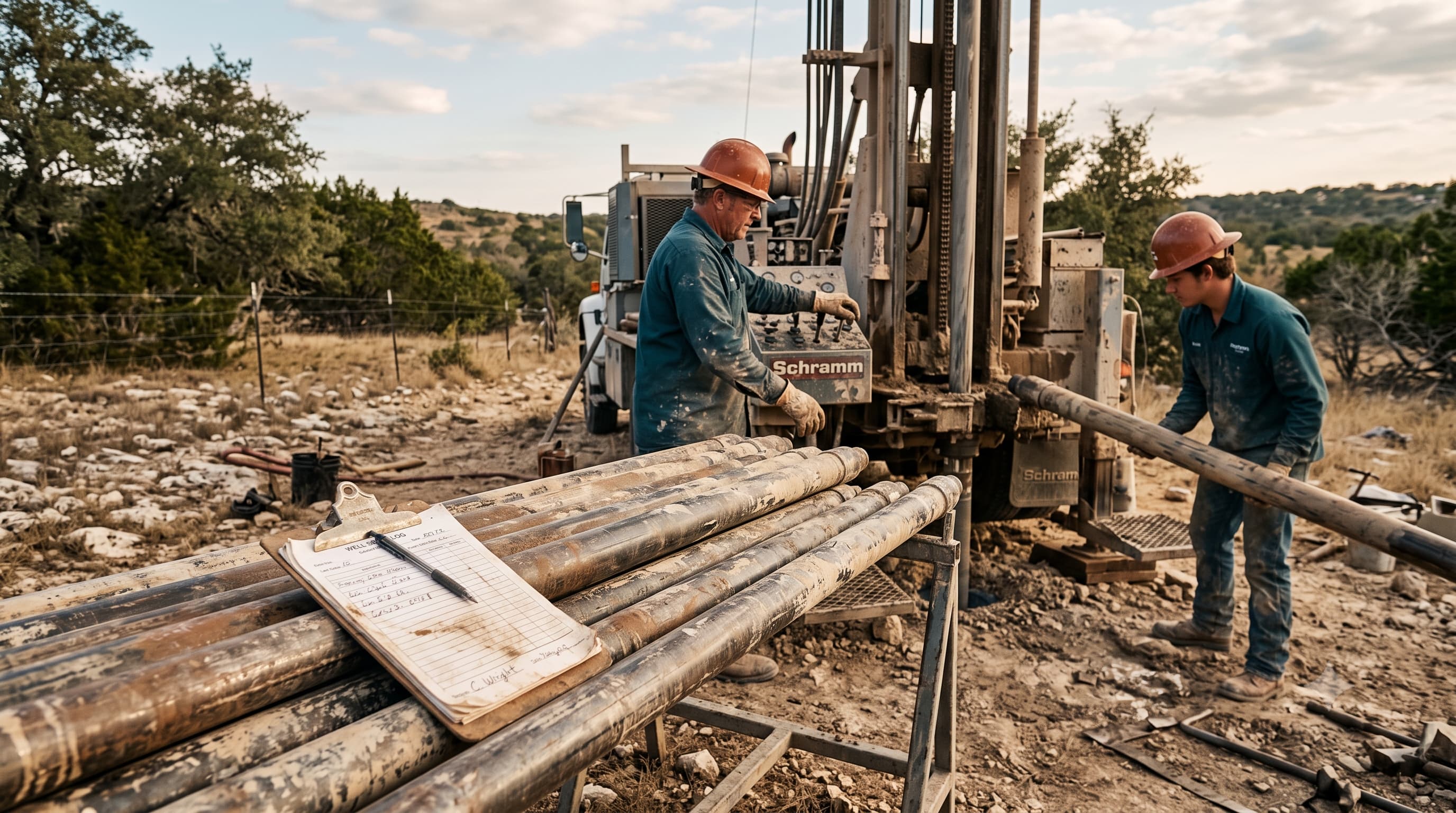
It's the first question everybody asks, and the honest answer starts with an uncomfortable admission: nobody can tell you the exact price of your well before they drill it. What we can do is tell you the rate, tell you what changes it, and give you a range that has held up across twelve thousand wells.
Wells are priced per foot, not per well
Across the country, complete well installation typically runs $25 to $65 per foot, with $25 to $35 per foot a reasonable guideline for most residential jobs. In Central Texas, a complete new well and pump system usually lands between $3,000 and $15,000.
That's a wide range, and the width is the point. A 180-foot well on an easy site with a simple pump is a different animal from a 420-foot well through hard limestone that needs 80 feet of steel casing. Per-foot pricing is how an honest driller keeps from either overcharging the first customer or losing money on the second.
What a complete well actually includes
When you compare two estimates, make sure they cover the same scope. A complete residential installation should include:
- Site assessment and well siting
- Permitting and state reporting
- Drilling to completion depth
- Casing — steel or PVC, to the depth the formation requires
- Grouting the annular space to seal out surface contamination
- Well development and disinfection
- The pump, motor, drop pipe and wire
- Pressure tank, switch, and controls
- The line from the well to the house
- Flow testing, startup, and a water sample
If a number looks unusually low, it is usually missing the last four items. A well that produces water into a pipe on the ground is not a water system.
The four things that move the number
1. Depth
The biggest variable by far. Most residential wells in the U.S. run 100 to 400 feet. In our six-county area, west of I-35 you're often into limestone and completing shallower; east toward the Blackland you drill through more clay to reach productive sand. We pull nearby well logs before quoting so the estimate starts from evidence rather than optimism.
2. Geology and casing
Soft, unstable formations need more casing, and casing is one of the more expensive materials in the hole. Hard rock drills slower but often needs less of it. Which one you have is a function of your address, not your budget.
3. Equipment
A standard submersible pump and a conventional bladder tank is the economical setup. A variable-speed constant-pressure system costs more up front and delivers city-like pressure with far less pump cycling. Neither is wrong; they're different trade-offs.
4. Access and distance
A rig needs to physically reach the drilling location. Tight lots, soft ground, long runs from the well to the house, and electrical service that has to be extended all add real cost. Walk your site with your driller before you sign anything.
The costs people forget
| Item | Typical range | Notes |
|---|---|---|
| Permit | $200 – $500 | Required in Texas; we file it for you |
| Water testing | $100 – $300 | Coliform and nitrate at minimum |
| Electrical service | Varies widely | Only if power isn't already at the well |
| Well house or cover | $500 – $2,500 | Freeze protection and equipment shelter |
| Treatment equipment | $1,500 – $5,000 | Softener and/or iron filtration, if needed |
Treatment is the one that surprises people. Central Texas water is hard almost everywhere and carries iron in a lot of places. It's worth budgeting for a softener even if you decide to add it in year two.
Is a well worth it?
If you're on acreage outside a municipal service area, it usually isn't a choice. If it is a choice, the arithmetic is straightforward: a well is a capital cost with essentially no monthly bill, against a water utility with no capital cost and a bill forever. Wells win on a long enough horizon, and the horizon is shorter than most people expect. A properly built well can produce for forty years.
“The cheapest well anybody ever drilled is the one that's still producing in year thirty. Everything else is a down payment on a second well.”
How to compare estimates
- Confirm the per-foot rate and exactly what it includes
- Ask what the rate is if the well goes deeper than estimated
- Confirm casing depth and material are specified, not assumed
- Confirm grouting is included — this is what protects your water
- Check who handles permitting and state reporting
- Compare warranty: labor and manufacturer are two different things
- Ask whether crews are employees or subcontractors
If you want a number for your specific property, we'll pull the logs for your area and give you a written per-foot estimate at no charge. It costs you nothing and it's a great deal more useful than a national average.